

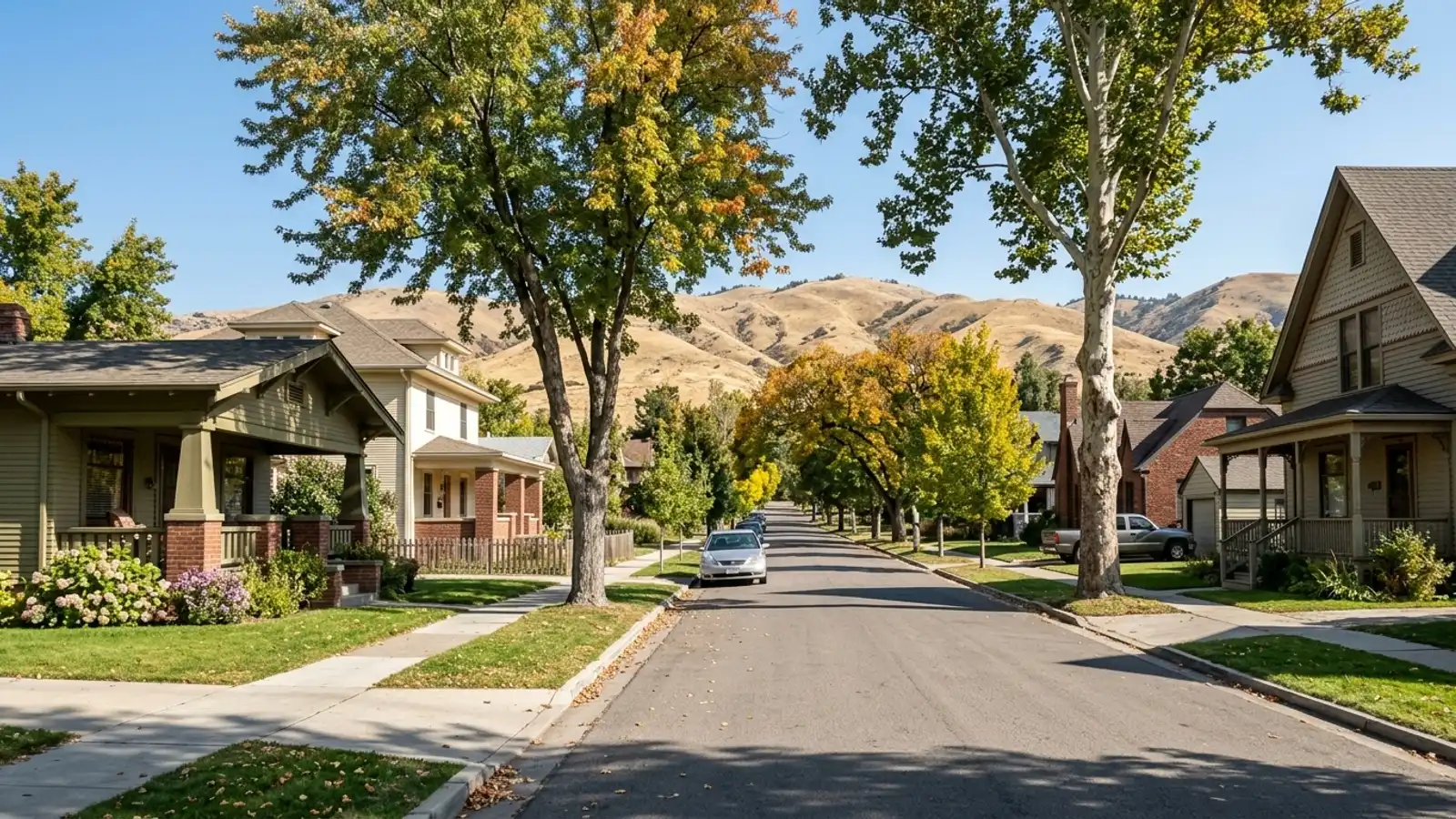
Close-in, older Boise housing is where buyers face the stiffest competition. No central ranking page prices the North End against its immediate neighbors, leaving buyers to guess how much of a premium they’re paying for a historic street.
The neighboring East End recently saw single-family homes sell above list price and well above the citywide per-square-foot median. A North End shopper’s real decision comes down to paying list or above for location, moving to the Bench for about 50% more space per dollar, or negotiating on a downtown-area condo where homes sit for a median 43 days.
Key takeaway
Start with the North End if you want an older home between downtown Boise and the foothills, but plan to offer at or near asking price. If that price or pace is out of reach, the Bench gives you the most space for the money of the nearby areas tracked here, and condos near downtown are where buyers still have room to negotiate.
At a glance
At a glance (90 days ending September 30, 2026):
- Boise, all homes: median sale price $540,742 (+2.4% year over year), 1.4 months of supply, 404 homes in inventory
- Boise, single family: median $554,779 (+2.7%), 12 median days on market, 99.7% sale-to-list, 27.4% sold above list, $326 per sq ft, 1.3 months of supply, 734 sales
- Boise, condo: median $479,851 (+15.6%), 43 median days on market, 99% sale-to-list, 9.6% sold above list, $391 per sq ft, 53 sales
- Boise, townhouse: median $415,005 (+9.2%), 28 median days on market, 98.8% sale-to-list, 16.4% sold above list, $297 per sq ft, 93 sales
- East End, single family: median $890,852 (+4.9%), 11 median days on market, 100.4% sale-to-list, 36.7% sold above list, $410 per sq ft (based on 19 sales; small sample, so treat as directional)
- Collister, single family: median $549,909 (-5%), 8 median days on market, 100.3% sale-to-list, 37.8% sold above list, $364 per sq ft, 30 sales
- Bench, single family: median $514,914 (+8.4%), 20 median days on market, 99.6% sale-to-list, 30.7% sold above list, $273 per sq ft, 40 sales
Who this guide is for
You’re weighing a home in Boise’s North End against nearby neighborhoods and need to know what close-in living costs and how hard you’ll have to compete for it.
North End Boise real estate: what close-in living costs
The Intermountain MLS existing-home report for September 2026 shows the North End and Northwest Boise area with a median sold price of $566,500. That sits slightly above the Boise single-family median of $554,779, and the gap between those two numbers shows up directly in how much square footage you can buy.
For the bigger picture, see Best Neighborhoods in Boise.
The North End Historic District was the city’s first suburban development, with an intensive 25-year building boom starting in 1891. The housing stock consists of early-1900s bungalows, Craftsman and Victorian-era homes, cottages, and some newer infill builds. Boise has ten designated historic districts, and the North End includes the Harrison Boulevard and Hays Street districts.
That citywide single-family median works out to about 1,840 square feet on a $600,000 budget. That same budget gets you about 1,460 square feet at the East End’s per-square-foot rate, about 1,650 at Collister’s $364, and about 2,200 at the Bench’s lowest per-square-foot rate of the areas compared here. The East End figure rests on just 19 sales, so treat it as a general direction rather than an absolute rule.
You can check citywide trends on our Boise housing market page to see how these figures fit into the broader area. The tradeoff in this part of town is straightforward: older homes on smaller lots mean less square footage and more upkeep per dollar.
Living in the North End
The North End Neighborhood Association’s boundaries run from State Street to Hill Road, and from 4th to 28th Streets. Inside those lines, daily life revolves around a few specific commercial and outdoor anchors.
Hyde Park is a local and National Register historic district centered on North 13th Street. Commercial buildings and neighborhood stores sit along the two blocks from Alturas Street to Brumback Street, covering everyday dining and shops. Just north of that strip, the 63-acre Camel’s Back Reserve connects directly to Hulls Gulch Reserve, with a trailhead into the Boise Foothills and the Ridge to Rivers trail network.
Residents can walk or bike to these trails, Boise State, or downtown. Valley Regional Transit runs bus service through the area: Route 16 travels through the North End to the VA Medical Center via 15th Street and Hyde Park, Route 9 runs along State Street on the neighborhood’s northern edge connecting Main Street Station downtown to Gary and Bunch, and Route 21 travels northwest from downtown along Hill Road, zig-zagging through the North End before looping south.
What you give up here is easy parking and modern vehicle storage. Older homes rarely have garages, street parking gets tight near Hyde Park and the parks, and the foothill-edge streets can be steep and slick in winter. You can read our guide to the pros and cons of living in Boise for a broader look at citywide lifestyle tradeoffs.
How to narrow your search
That budget forces a choice between location and square footage. Choosing between the North End and its neighbors comes down to how much space you need and how fast you can write an offer. Ask yourself these four questions to find the right starting point.
- Do you need to be within a short walk or bike ride of downtown, Hyde Park, and the foothill trails? If yes, start with the North End and the East End profile below. If a short drive is fine, read the Collister and Bench sections.
- Is price per square foot your hard limit? Run your budget through the worked example in the previous section, then go straight to the Bench profile.
- Can you write a clean offer at or above asking within days of a listing going live? If not, read the condos and townhomes section, where sellers have waited longest.
- Do you plan to add on to, re-side, or remodel an older house? Read the historic district rules in the buying section before you shortlist specific streets.
North End vs nearby Boise neighborhoods
The four alternatives buyers most often weigh against the North End each carry different price points, competition levels, and locations. Each nearby area requires a different timeline and budget. You can compare these figures to other parts of town in our guide to the best neighborhoods in Boise.
East End
The East End offers the closest match to North End housing, with older homes sitting between downtown and the foothills. It’s also at the top of the nearby price range. The single-family median reached $890,852 over the 90 days ending September 30, 2026, based on 19 sales, and more than a third of those sold above asking price.
Because that median rests on a small sample, one or two large sales can move the number significantly. Treat it as a directional indicator rather than a fixed baseline.
The cost is the constraint. It is the most expensive of the four alternatives, requiring a higher budget for the same proximity to the city center.
Collister
Collister sits on Boise’s northwest side, with single-family prices near the citywide median. Prices fell 5% over the year ending September 30, 2026, yet the typical home still sold in a median of 8 days.
Lower prices have not given buyers much room to negotiate. You’ll need financing lined up and the ability to tour and offer within days of a property going live. Drive or ride your route to downtown at rush hour before you commit, since the distance is what you’re trading for the lower price.
The Bench
The Bench gives you the most house per dollar near central Boise. At $273 per square foot, that budget buys roughly 50% more space than the East End’s per-square-foot rate allows. The single-family median was $514,914 over the 90 days ending September 30, 2026, across 40 sales, and homes took a median 20 days to sell, the most breathing room of the single-family areas on this page.
The catch is location. You trade the North End’s walk-or-bike access to Hyde Park, downtown, and the foothill trails for that extra space. The Bench sits south of the river, so daily errands and trail time likely mean driving.
Condos and townhomes near downtown
Attached homes offer a lower-entry, negotiable route for buyers who want to stay close in but can’t win single-family bidding wars. Boise condos sat a median 43 days on market, long enough that the asking price is a starting point rather than a floor. The Boise townhouse median was $415,005 citywide over the 90 days ending September 30, 2026.
You give up a yard and add HOA dues, rules, and possible rental limits. Condo prices citywide also rose fastest of any type over the past year, so the negotiating room is on terms and timing rather than deep discounts. You can review our condos and townhomes guide for more details on styles and prices, and ask the HOA for current dues, the reserve study, special assessments, and rental rules before offering.
Buying a home in the North End
Over the 90 days ending September 30, 2026, Boise single-family supply sat at 1.3 months, keeping the area in a seller’s market. During that window, 27.4% of single-family homes sold above list price. Have your pre-approval in hand and decide your ceiling before you start touring.
Historic district rules matter here. Most exterior changes in the city’s historic districts require a Certificate of Appropriateness for modifications outside of standard maintenance, covering new construction, additions, accessory buildings, and exterior changes like siding and windows. Ask the listing agent or the City of Boise whether the property is inside a historic district, and whether past exterior work had a certificate of appropriateness.
Older homes require specific due diligence. Have the inspector cover the electrical, plumbing, foundation, and roof, and order a sewer scope. For homes built before 1978, review the federally required lead-based paint disclosure and consider testing. Confirm the home’s year built on the Ada County Assessor record rather than relying on the listing.
The North End is served by the Boise School District. Confirm your school assignment with the Boise School District’s boundary lookup tool, as listing remarks can be inaccurate. For crime data, search the specific address on the Boise Police Department’s public portal and compare the same date range and offense types across areas to see how different streets match up.
If you’re moving from out of the area, review our relocation guide for Boise property taxes and commutes, and check our timeline for buying sight unseen. You can also read our steps for buying a home in Boise to compare cash offers, closing costs, and financing.
North End Boise FAQs
Is the North End in Boise a suburb?
No. It’s a neighborhood inside Boise city limits, directly north of downtown, bounded by State Street to the south, Hill Road to the north, and 4th to 28th Streets.
What is the North End in Boise?
The North End is one of Boise’s oldest residential neighborhoods, represented by a neighborhood association and containing designated historic districts, including the Harrison Boulevard and Hays Street districts.
What zip code is the North End in Boise?
The North End is covered by the 83702 and 83703 zip codes. Zip code lines don’t perfectly match neighborhood boundaries, so you can check our Boise zip codes page to see how they overlap.
How old are homes in the North End?
The North End Historic District was the city’s first suburban development, with its first neighborhood platted in 1878. An intensive 25-year building boom began in 1891, though infill construction means build years vary widely. Confirm the exact year built on the Ada County Assessor record, which will tell you whether you need a pre-1978 lead disclosure.
How does parking work in the North End?
The City of Boise runs a citywide Residential Parking Permit Program that lets eligible residents obtain an on-street E-permit for their designated zone. Visitor passes cost $5 each after a resident has an approved permit, and housing developments with off-street parking are not eligible. Confirm permit eligibility for your specific street with the city’s parking services office.
Can I build an ADU on a North End lot?
It depends on the lot size and historic designation. Under Boise’s zoning code, an accessory dwelling unit can’t be larger than 900 square feet or 70% of the total floor area of the primary structure, and only one ADU is permitted per lot. Lots in a historic district may also need design review, as most exterior changes require a Certificate of Appropriateness from the city.
What hospital is closest to the North End in Boise?
St. Luke’s Boise Medical Center is located downtown. Check a mapping app for the exact drive time from the specific central North End street you’re considering.
What is the weather like in the North End?
The North End shares the city’s semi-arid climate, which produces an average of just over eleven inches of rain and melted snow per year. The normal average maximum temperature for the year is 64.3 degrees Fahrenheit. Foothill-edge streets in the North End can be slick during winter snow.
Sources
- Redfin: Data Center
- North End Neighborhood Association: Boundaries
- City of Boise: Historic Districts
- City of Boise: Historic Preservation
- City of Boise: North End Historic District
- City of Boise: Hyde Park Historic District
- City of Boise: Camel’s Back Reserve
- Boise School District: Attendance Areas
- City of Boise: ADU One Sheet
- City of Boise: Parking Permits
- National Weather Service: Boise Climate Summary
- Valley Regional Transit: State Street Route
Social Cookies
Social Cookies are used to enable you to share pages and content you find interesting throughout the website through third-party social networking or other websites (including, potentially for advertising purposes related to social networking).