

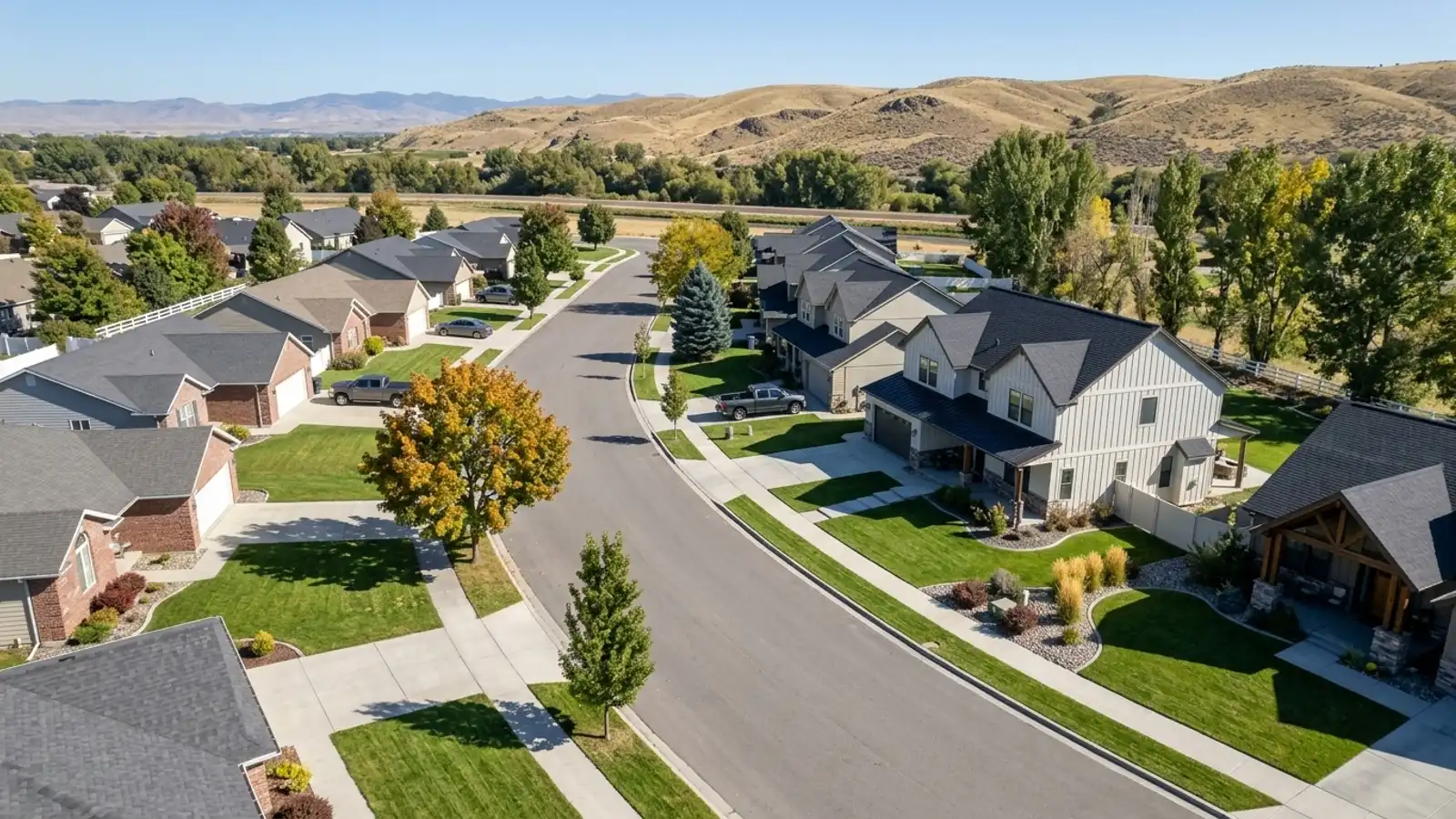
Eagle’s crime picture is a town-level number you look up once. The safety risks that change what you pay, such as Boise River flood zones and foothills wildfire exposure, are set address by address.
With single-family homes taking a median 66 days to sell on 2.6 months of supply, most Eagle buyers have time to run those parcel checks before they commit. Official police data, fire response, and the environmental factors worth verifying during your inspection period are each covered below.
Key Takeaway
Check Eagle’s crime rate at the town level in the FBI’s Crime Data Explorer. Then put most of your effort into the address-level risks that affect cost: whether the home sits in a FEMA flood zone near the Boise River, and how exposed it is to wildfire in the foothills. Single-family homes are taking a median 66 days to sell, so there’s usually time to pull the flood map and an insurance quote before you commit, while townhouses give you even more room.
Who This Guide Is For
You’re weighing a move to Eagle, or a specific home there, and want to check crime and hazard risk before you commit.
Eagle Crime Rates and Official Data
In 2024, the FBI reported a national estimated violent crime rate of 359.1 incidents per 100,000 inhabitants. Measuring Eagle against that requires specific state and national benchmarks from the same year.
The Idaho State Police’s 2024 Crime in Idaho Statewide Crime Profile puts the statewide violent crime rate at 234.0 per 100,000 residents and the property crime rate at about 1,378.24 per 100,000 residents. Those are your baseline before you get to Eagle’s own numbers.
Eagle Crime Rates Compared with Idaho and the US
A third-party compilation of 2024 FBI data released in September 2025 reports Eagle’s overall crime rate at about 80% lower than the national average, with a 7% year-over-year decrease. If you want a fair comparison with another Treasure Valley city, use the FBI Crime Data Explorer, the same year, and per-100,000 resident rates throughout.
One caveat: for a city Eagle’s size, a handful of incidents can swing a per-100,000 rate noticeably. One year is a snapshot. Read at least three years of data before drawing any conclusion.
How to Read Eagle Crime Statistics
Different platforms present public safety data differently. NeighborhoodScout bases its analysis on the seven offenses from the FBI’s Uniform Crime Reports and concludes that Eagle reports a rate lower than 65% of U.S. cities and about 49% to 51% of Idaho communities.
Aggregator grades are modeled estimates that blend data sources and can disagree with each other. Incident maps show raw events without adjusting for population. Neither replaces the official count. Look up Eagle’s town-level totals yourself on the FBI Crime Data Explorer, comparing at least three years.
Which Safety Checks Matter for Your Search
Every property in Eagle has its own specific hazard profile based on its location. The steps worth taking depend on where the house sits and what type of property it is.
Is the home near the Boise River, a pond, or an irrigation canal? Go to the flood risk section below, then check the fire and emergency medical service section for insurance rating details.
Is the home in the foothills or backing onto open, undeveloped land? Go to the wildfire risk section and the fire and emergency medical service section.
Are you comparing Eagle’s crime with another city? Go to the crime rate comparison, then read how to read Eagle crime statistics so you’re comparing the same source, year, and rate.
Are you shopping single-family homes or townhouses? Go to the single-family or townhouse sections to see how much time you’re likely to have for checks and negotiation.
Who Answers Police, Fire and Medical Calls in Eagle
Eagle doesn’t operate an independent, standalone city police department. Instead, the city contracts its law enforcement services through the county. Knowing who responds to a 911 call tells you where to look for official records and who to contact for non-emergency issues.
Law Enforcement in Eagle
Since 1996, the City of Eagle has contracted with the Ada County Sheriff’s Office for law enforcement services. The current Eagle Police Chief, Travis Ruby, is a Lieutenant with the Ada County Sheriff’s Office.
When a county agency patrols a city under contract, Eagle’s incidents may be filed under the sheriff’s office rather than a city department. City-only figures can be harder to isolate as a result, so confirm which agency’s data you’re reading when researching a specific area.
Fire and Emergency Medical Service
The Eagle Fire Protection District operates multiple stations serving the area, including Station 1 on East Iron Eagle Drive and Station 2 near Floating Feather Road and Horseshoe Bend Road, with a third planned off Highway 55 and Beacon Light Road. For medical calls, Ada County Paramedics operates Station 26 on East State Street as part of its countywide network.
Distance to the nearest staffed station and hydrant access can change a home’s insurance protection class. Ask your insurer for the fire protection class on the specific address, particularly at the edge of town or in the foothills.
Natural Hazards to Check for a Specific Eagle Address
The City of Eagle notes that flooding in the area can be caused by two sources: Dry Creek and the Boise River. Natural hazard exposure changes parcel by parcel and directly affects what you’ll pay for insurance.
Federal law mandates that federally regulated or insured lenders require flood insurance for any building located in a Special Flood Hazard Area with a federally backed loan.
Flood Risk Along the Boise River
Eagle participates in the National Flood Insurance Program, which allows property owners in mapped high-risk areas to obtain federally backed flood insurance. The city cites FloodSmart.gov’s estimate that a structure in a Special Flood Hazard Area has a 26% chance of flooding over a 30-year mortgage. Look up the exact address on the FEMA Flood Map Service Center and ask your lender for the flood zone determination.
A flood map shows mapped zones, not every risk. High groundwater, ponds, and irrigation canals can matter even outside a mapped zone, and a standard homeowners policy doesn’t cover flood damage.
Wildfire Risk in the Foothills
Homes in the foothills north of town often sit in the wildland-urban interface, where residential properties meet open grass and sagebrush. Official USDA Forest Service figures for Eagle aren’t available, but the risk-modeling firm First Street reports that about 99% of properties in Eagle face some wildfire risk over the next 30 years. Check the address in the federal Wildfire Risk to Communities tool if the home backs onto open land.
Homes in that position can cost more to insure, and some carriers limit coverage there. Get binding homeowners and, if relevant, flood insurance quotes for the specific address before your inspection or due-diligence period ends, not after.
Swimming and Water Safety at Eagle Island State Park
Eagle Island State Park features a developed sandy swimming beach on its main pond that’s popular in the summer. The park explicitly has no lifeguards on duty at the designated swimming beach, and the water has previously been closed temporarily after illness reports, including confirmed cases of norovirus linked to swimming there.
The Boise River runs fast and cold during spring runoff, even on warm days. Check current Boise River flows on the USGS gauge before floating or swimming, and don’t assume the park’s swim area conditions apply to the river.
How Much Time the Eagle Market Gives You to Run These Checks
Across all property types, Eagle homes recently spent a median of 70 days on the market. How much room you have to conduct hazard and insurance checks depends on the type of home you want to buy.
Inventory levels and buyer competition dictate whether you can secure a standard inspection period or whether you need to pull parcel data before writing an offer.
Single-Family Homes
Single-family homes in Eagle recently saw 2.6 months of supply. If you want a single-family home without losing it to a faster buyer while you check hazards, pull the FEMA flood map and an insurance quote for the address before writing the offer.
Nearly one in five single-family homes (18.1%) sold above list price. On the most in-demand listings, sellers may push for short contingencies, so having your hazard data ready early matters.
Townhouses
Townhouses currently offer 5.6 months of supply, and zero percent of recent sales closed above asking price. If you want the most time and room to run flood, wildfire, and insurance checks before committing, start with townhouses.
These figures rest on only 27 sales, so they can shift quickly. An HOA master insurance policy rarely covers flood or your interior, so ask the HOA for its master policy and what it covers, along with current dues, and get your own quote.
Living in Eagle Beyond Safety
Daily life and ongoing costs matter just as much as hazard zones and emergency services. Weigh the pros and cons of living in Eagle, including access to the Boise River Greenbelt and local commute times.
Check Eagle housing market trends for specific neighborhoods by subdivision, and review the different zip codes and areas to see which fits your budget. Factor in buyer closing costs, current mortgage rates and financing options, and the differences between property types, condos, and HOAs. If you need help pulling flood zone maps or insurance information on a home you’re considering, the right place to start is with the parcel data for that specific address.
At a Glance
- Median sale price, all homes: $899,572 (90 days ending 2026-09-30), up 12.5% year over year, 310 homes sold
- Median sale price, single family: $997,053 (90 days ending 2026-09-30), up 8% year over year, 280 homes sold
- Median days on market: single family 66, townhouse 80 (90 days ending 2026-09-30)
- Sale-to-list ratio: 99% for both single family and townhouse (90 days ending 2026-09-30)
- Share sold above list: single family 18.1%, townhouse 0% (90 days ending 2026-09-30; townhouse figure based on 27 sales)
- Months of supply: all homes 2.9, single family 2.6, townhouse 5.6 (90 days ending 2026-09-30)
- Homes for sale (inventory): all homes 296, single family 237, townhouse 49 (90 days ending 2026-09-30)
- Median sale price, townhouse: $460,455 (90 days ending 2026-09-30), up 1.4% year over year, based on 27 sales
- Median price per square foot: all homes $345, single family $350, townhouse $250 (90 days ending 2026-09-30)
Eagle, ID Safety and Living FAQs
Is Eagle, Idaho a Wealthy Area?
The median sale price for a single-family home in Eagle is $997,053, with a median of $350 per square foot. Property values here are among the highest in the Treasure Valley.
Is Eagle, Idaho Expensive to Live In?
Yes. The all-homes median sale price sits at $899,572, up 12.5% year over year. That gain partly reflects more single-family sales in the mix, and buyers should review local buyer closing costs and mortgage rates and financing to understand the full financial picture.
How Close Is Eagle to Boise?
The driving distance from Eagle to downtown Boise is roughly 10 to 11.4 miles, taking about 20 to 25 minutes by car under normal conditions. It’s also approximately 15 miles from the Boise Airport, though you should check drive times at your own commute hour.
Is Eagle Part of Boise?
No, Eagle is its own incorporated city located in Ada County. Law enforcement is provided by the Ada County Sheriff’s Office under a contract the city has held since 1996.
What Are Winters Like in Eagle, Idaho?
December is typically the coldest month, averaging a high near 38 degrees and a low near 25 degrees, with the metro area averaging about 20 inches of snowfall annually. The Treasure Valley is also subject to wintertime temperature inversions that trap cold air and pollutants near the ground, resulting in poor air quality.
Does Eagle Island State Park Close for the Season?
The park is open year-round, but the designated swimming beach and specific facilities may have seasonal hours or closures. Confirm current hours and any day-use fees with Idaho Parks and Recreation before visiting.
What Are the Pros and Cons of Living in Eagle, Idaho?
A major advantage is the easy access to the Boise River and Eagle Island State Park. The primary downside is the high cost of housing compared to neighboring cities. You can compare more details in the guide to the pros and cons of living in Eagle.
What Is There to See in Eagle, Idaho?
Visitors and residents frequent Eagle Island State Park, the Boise River Greenbelt, and the nearby foothills trails. These outdoor spaces offer extensive paths for walking, biking, and recreation throughout the year.
Sources
- Idaho State Police: Crime in Idaho
- FBI: UCR Summary of Reported Crimes in the Nation, 2024
- AreaVibes: Eagle, ID Crime
- City of Eagle: Police
- FireRescue1: Idaho fire district breaks ground on station
- City of Eagle: Floodplain Information
- FEMA: Know Your Risk
- Idaho Friends: Eagle Island Narrative
- National Weather Service: Boise Climate Summary
- Idaho DEQ: Priority Areas
- Mapsof.net: Distance Eagle to Boise
- ClosestAirportTo: Eagle, ID
- Redfin: Data Center
Social Cookies
Social Cookies are used to enable you to share pages and content you find interesting throughout the website through third-party social networking or other websites (including, potentially for advertising purposes related to social networking).