

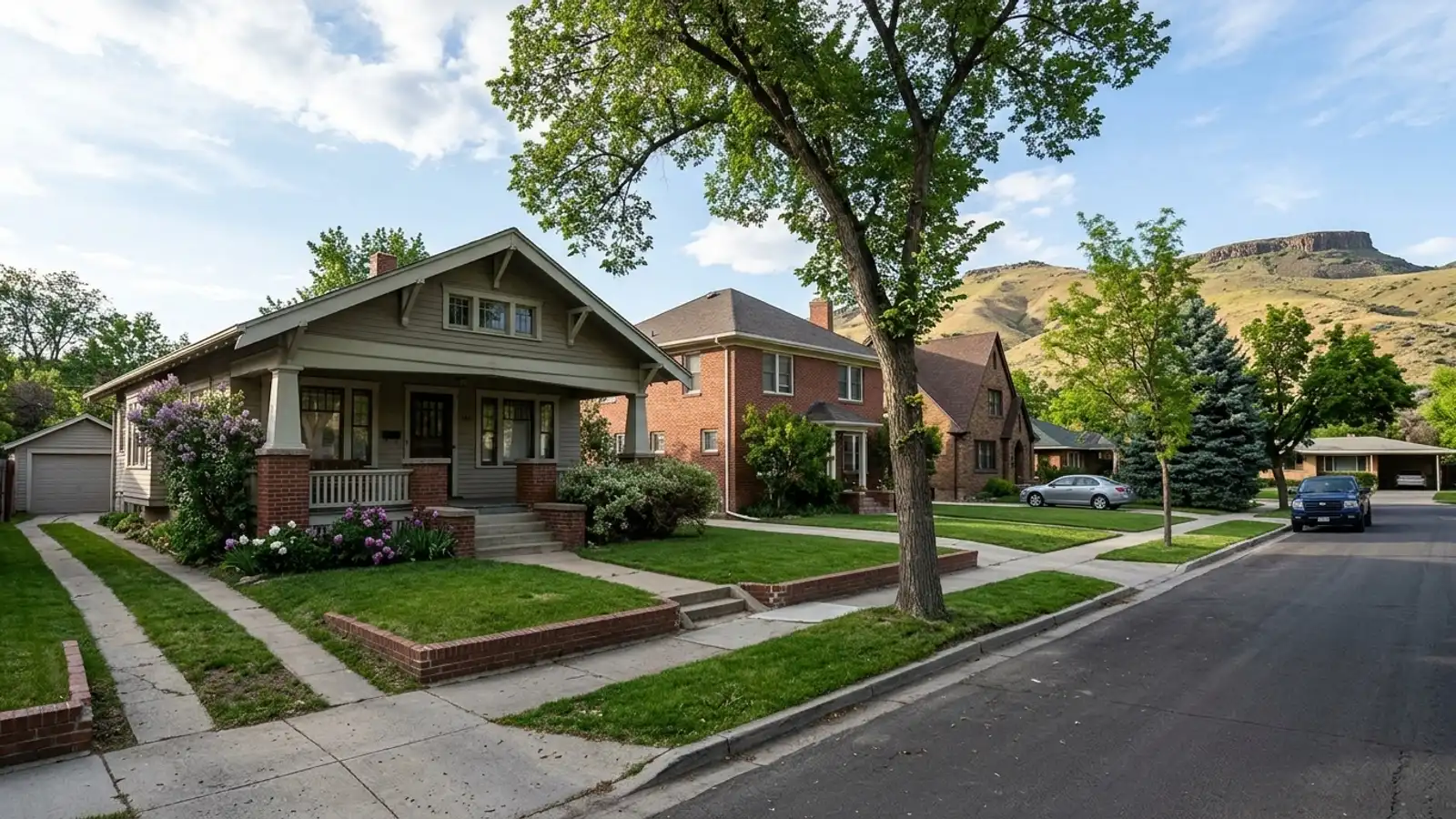
Boise’s East End sits directly between the downtown grid and the foothills, holding some of the city’s oldest residential streets. No real estate market data tracks the East End as its own standalone region, which means buyers can’t rely on automated neighborhood averages to understand what a house here should cost.
To price a home in this area, you have to pull recent sold comparables specifically for the East End and weigh them against what you’d pay for similar space in other parts of the city. The East End asks you to weigh what you trade away by choosing it: square footage, a faster closing, or newer construction.
Key Takeaway
Pick the East End if a short trip to downtown and the foothills trails matters more to you than square footage. No automated source tracks this area separately, so price any house there against recent East End sales rather than citywide averages. If space per dollar matters more, start with the Boise Bench, where single-family homes sold at the lowest median price per square foot of the neighborhoods compared here over the 90 days ending September 30, 2026.
Who This Guide Is For
This guide is for buyers weighing a home in Boise’s East End and deciding if its spot between downtown and the foothills is worth paying for over the Bench, Collister, or the North End.
What Is the East End in Boise?
The East End covers roughly 3.66 square miles, bounded by the Boise River to the south, the Boise Foothills Tram Trail and Warm Springs Mesa to the east, and Broadway Avenue, Second Street, and West Fort Street on its other sides. The area’s boundaries expanded in 2016 to include Fort Boise, Military Reserve, and the Shaw Mountain Road area. The residential streets hold older homes, most notably along the Warm Springs Avenue historic district, which extends from Broadway Avenue to Marden Street. Buyers evaluating different parts of town can browse profiles of popular Boise neighborhoods.
Homes along Warm Springs Avenue include styles like Queen Anne, Bungalow, and Colonial Revival, with contributing properties dating from the 1879 Maynard House through the 1930s. Some homes along this avenue have been heated by geothermal water since the 1890s, when the nation’s first district heating system was created here. Today, the Boise Warm Springs Water District still serves about 350 houses and businesses with an open system of geothermal water.
The downside of the East End’s unique geography is that list-price anchoring happens easily without automated data to keep expectations in check. Pull recent sold comps to see what buyers paid before making an offer.
East End Homes and Prices
Single-family homes in Boise recently sat at just 1.3 months of supply, meaning buyers should expect competition rather than discounts on East End houses. Over the 90 days ending September 30, 2026, the citywide median sale price for a single-family home was $554,779, or a median $326 per square foot.
To put those citywide numbers into perspective for an East End search: an 1,800-square-foot house at that median per square foot costs about $586,800. That same space at the Boise Bench median runs about $491,400. Ask your agent where recent East End sales land per square foot against those two numbers to gauge the area’s location premium.
What you give up with an older East End home is predictability during the inspection period. Older homes can bring surprises, so ask the seller for 12 months of heating and utility bills, confirm whether the home is on geothermal service, and check its historic-district status before planning renovations. You can track broader citywide trends on our Boise housing market page.
East End vs. Nearby Boise Neighborhoods
Because the East End lacks its own market data, the most practical way to evaluate it is by looking at the alternatives. Buyers typically weigh the East End against the Bench for space, Collister for a different foothills edge, and the North End for a similar historic setting.
Each alternative offers a different trade-off in price, pace, or housing style. Comparing them clarifies whether you’re paying for the house itself or the specific location.
Boise Bench
The Boise Bench is where the East End’s location premium turns back into square footage. Single-family homes here sold for a median $514,914 over the 90 days ending September 30, 2026, based on 40 sales. At a median $273 per square foot, it offers the most detached-house square footage per dollar near central Boise.
The discount is shrinking, though. Bench single-family prices rose 8.4% year over year against 2.7% citywide, so waiting may cost you some of that space advantage.
Collister
Collister offers the closest like-for-like foothills-edge comparison to the East End. Single-family prices fell 5% year over year to a median $549,909 over the 90 days ending September 30, 2026. Despite that price drop, homes still moved in a median 8 days and sold at 100.3% of list price.
What you give up is negotiating room. With homes going in about a week, you need financing and inspection plans ready before touring. Treat these figures with some care, too: they rest on just 30 sales.
North End
The North End is the standard comparison for buyers who want an older, close-in neighborhood rather than the East End specifically. Like the East End, the North End isn’t tracked separately, so you’ll be comparing the two areas on recent sold comps alone.
That’s the catch. You have to ask your agent for both sets of comps over the exact same window to make an accurate comparison.
Living in the East End
Daily life in the East End revolves around immediate proximity to both the downtown core and the Boise Foothills. Residents trade the convenience of large commercial centers for direct access to outdoor recreation and historic streetscapes.
The location requires some specific logistical planning. Map your daily routines before you fall in love with a house to make sure the trade-off works for your schedule.
Foothills Trails, Parks, and the Greenbelt
The Old Idaho Penitentiary, which held prisoners for about a century, sits at the base of the Table Rock foothills on the East End’s edge. Built in 1870, it operated until 1973 and now functions as a history museum and a primary access point for the area’s trail system.
The penitentiary lot provides parking for the Mesa Reserve Trailhead, Table Rock trails, and the Boise River Greenbelt. Nearby in Military Reserve, residents use the Cottonwood Creek Trailhead and Freestone Trailhead along Mountain Cove Road.
Living against the foothills does come with wildland-urban interface exposure. The 2016 Table Rock Fire burned nearly 2,500 acres of native grassland and destroyed one home in the area. Boise requires homes in these zones to meet specific ignition-resistant construction codes, so get a homeowners insurance quote, including wildfire coverage, during the inspection period.
Restaurants and Errands
The East End relies on downtown Boise for dining and retail options. Commercial options inside the neighborhood boundaries are limited, and most residents head west into the city center for a wider selection of restaurants and services.
Map your commute and grocery run at rush hour before committing to a house here.
How to Decide If the East End Fits Your Search
Deciding on the East End comes down to prioritizing location over square footage and ease of purchase. If you need a detached house within easy reach of downtown, the East End works. If space wins out, read the Boise Bench section and the worked example above to see the difference in price per square foot.
You also need to evaluate your readiness to compete. If you can’t write a clean, near-list offer within days of a listing going live, look at the Collister section to see how fast foothills-edge houses move, or consider townhouses, which took a median 28 days to sell citywide.
Then there’s the reality of older homes. If inspection findings, historic-district reviews, and foothills wildfire insurance give you pause, read the trails section and the historic-district FAQ before touring. If an older close-in neighborhood is the real goal rather than the East End specifically, compare comps from both the East End and the North End. You can weigh these factors against city-level pros and cons in our broader Boise living guide.
Finding a Home in the East End
Before you trust any list price, ask for 90-day sold comps specifically for the East End, complete with price per square foot. The single-family market remains competitive, so have your financing in order before scheduling tours.
For buyers moving from out of state, our relocation guide and relocation timeline cover how to plan your transition. Buyers handling the process from afar can also read our guide to buying a house sight unseen.
Rachel Hausman Masse’s Haus Team at Compass can pull current East End comps and set up showings or video tours when you’re ready to start. You can review the general buying steps and costs for the area to prepare for closing.
At a Glance
- Boise single-family: median sale price $554,779, up 2.7% year over year (90 days ending 2026-09-30, 734 sales)
- Boise single-family: median $326 per sq ft; median 12 days on market; 27.4% sold above list; 1.3 months of supply (90 days ending 2026-09-30)
- Boise condo: median sale price $479,851, up 15.6% year over year; median $391 per sq ft; median 43 days on market (90 days ending 2026-09-30, 53 sales)
- Boise townhouse: median sale price $415,005, up 9.2% year over year; median 28 days on market; 98.8% sale-to-list (90 days ending 2026-09-30, 93 sales)
- Bench single-family: median sale price $514,914, up 8.4% year over year; median $273 per sq ft; median 20 days on market (90 days ending 2026-09-30, 40 sales)
- Collister single-family: median sale price $549,909, down 5% year over year; median $364 per sq ft; median 8 days on market; 100.3% sale-to-list (90 days ending 2026-09-30, based on 30 sales)
- East End, North End and Southeast Boise: not tracked as separate regions in this data, so use recent sold comps for these areas
East End Boise FAQs
What ZIP Code Is the East End of Boise In?
The East End sits in the 83712 ZIP code. ZIP code lines don’t match neighborhood lines exactly, so you can check our Boise ZIP codes guide to see how the boundaries overlap.
What School District Serves Boise’s East End?
The Boise School District serves the East End. The district provides an official Attendance Area Address Lookup tool that lets residents enter an address to find the assigned elementary, junior high, and senior high schools. Look up the specific address in this tool rather than relying on listing remarks.
What Is the Weather Like in the East End of Boise?
The area has a semi-arid climate that averages just over 11 inches of precipitation a year, mostly falling between November and May. The average annual high temperature at the Boise Airport station is 64.3 degrees, and the average annual low is 42 degrees. Summer heat matters for older homes without central air, so ask your inspector about the cooling system.
Do East End Homes Have Geothermal Heat?
Yes, some homes along Warm Springs Avenue connect to the Boise Warm Springs Water District, an open system of geothermal water that serves about 350 houses and businesses. The City of Boise also operates a separate closed system downtown. Ask the seller for heating bills and confirm the provider if a home claims geothermal service.
Are There Historic District Rules for East End Homes?
Yes, Boise City Code requires a Certificate of Appropriateness for alterations or changes in use in historic districts. These certificates expire two years from the date of approval. Confirm with City of Boise Planning whether an address is in a historic district before buying a home with renovation plans.
What Hospital Is Closest to the East End of Boise?
St. Luke’s Boise Medical Center is located at 190 East Bannock Street, Boise, ID 83712, just west of the neighborhood. The hospital provides nearby medical access for East End residents.
Can I Rent Out an East End Home as a Short-Term Rental?
Yes, under Idaho Code effective July 1, 2026, no city may require a license, fee, or permit to operate a short-term rental. Boise can only enforce limited safety items like functioning smoke alarms and fire extinguishers, alongside general noise and parking ordinances. For any condo or townhouse, ask the HOA for current restrictions, as they can still limit rentals.
Sources
- East End Neighborhood Association: About the East End Neighborhood
- Wikipedia: Warm Springs Avenue Historic District
- World Geothermal Congress: Boise Geothermal Heating
- Redfin: Data Center
- Ridge to Rivers: Table Rock Area
- Idaho State Historical Society: Old Idaho Penitentiary
- Boise State University: Wildfire Resources
- Boise City Code: Wildland-Urban Interface
- Boise School District: Attendance Areas
- National Weather Service: Boise Climate Summary
- City of Boise: Historic Preservation Ordinance
- Centers for Medicare & Medicaid Services: St. Luke’s Medical Center
- Idaho State Legislature: Short-Term Rentals
Social Cookies
Social Cookies are used to enable you to share pages and content you find interesting throughout the website through third-party social networking or other websites (including, potentially for advertising purposes related to social networking).