

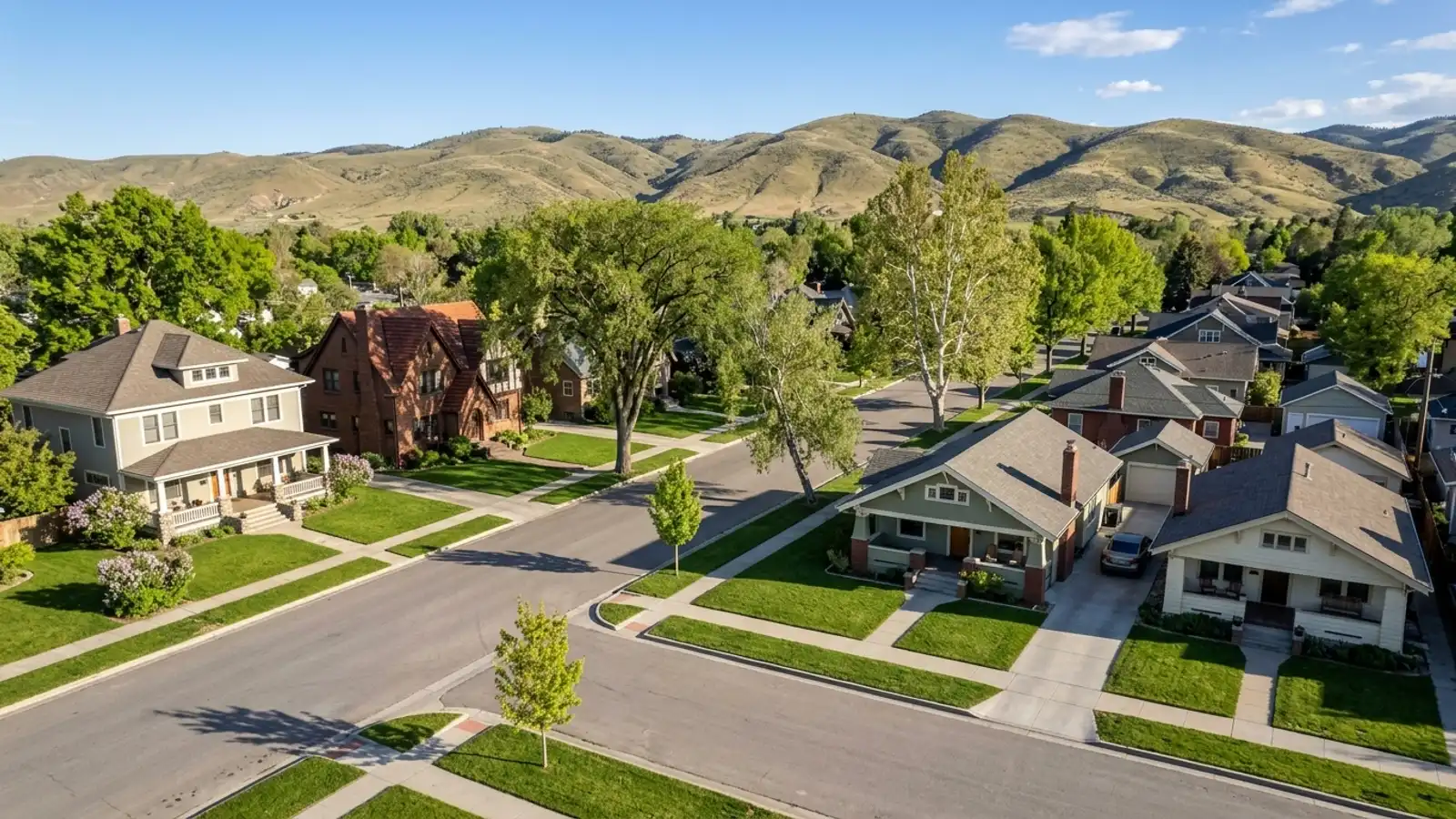
Boise’s luxury market tells two different stories depending on which number you look at. The neighborhood median gives you one picture; the price per square foot gives you another. Look at only one and you’ll likely misjudge what you’re buying.
The city’s priciest zip codes reward buyers who understand what the premium is paying for.
Key Takeaway
By recent sale prices, the East End is Boise’s most expensive tracked area, with a single-family median based on just 19 sales and buyers still bidding over asking. If you want central Boise for far less per square foot, the Bench is the alternative. The North End is often named alongside the East End, but price it from local comps because it is not included in the Redfin sales data used here.
Who This Guide Is For
You are comparing Boise’s priciest neighborhoods and deciding if the extra cost buys a better location, more house, or just a higher price per square foot.
What Makes a Boise Area Expensive?
Boise has two kinds of expensive. The East End costs the most by every measure. Collister sells near the city’s $554,779 single-family median yet charges $364 per square foot against the citywide $326. You pay a premium per foot there for a smaller home. The Bench, at $273 per square foot, buys you about 50% more space per dollar than the East End does. All rankings use Redfin sales data for the 90 days ending September 30, 2026.
For the bigger picture, see Best Neighborhoods in Boise.
Only the East End, Collister, and the Bench have neighborhood figures in that data. The North End and Southeast Boise are not included, so this guide carries no median for either. You can compare Southeast Boise against local comps when you’re shopping. Citywide condos average $391 per square foot, which adds another layer to the pricing scale. Check our Boise housing market update for broader citywide trends.
A 2,000-square-foot single-family home shows the gap clearly. At the East End’s $410 per square foot versus the Bench’s lowest rate in this guide, you’re looking at roughly $820,000 against $546,000, a difference of about $274,000. Dividing medians only gives a rough sense of home size, but the point stands: a dollar on the Bench buys significantly more space. Buyers interested in this area can read about living on the Bench in Boise.
Most Expensive Neighborhoods by Home Price
Boise’s highest total home prices cluster near downtown and the foothills, and buyers targeting these corridors face real competition for limited inventory. Many properties go under contract in less than two weeks.
Historic preservation rules and geographic constraints keep new construction rare here. That pushes demand toward older, updated homes that already command a premium.
East End
The streets near downtown and the foothills edge are genuinely competitive. In over a third of recent single-family sales, the asking price was the floor, not the ceiling. Some of these homes have been heated by geothermal water through a district system dating back to 1892, operated by the Boise Warm Springs Water District.
The single-family median sits at $890,852, with 36.7% of homes selling above list during the 90 days ending September 30, 2026, from a sample of just 19 sales. The city’s official GIS data shows the Warm Springs Avenue Historic District alone covers about 69 acres here.
Two things to know before you make an offer. Exterior changes on homes inside a city historic district require a Certificate of Appropriateness from the city, so you won’t have complete freedom over your property’s appearance. The other issue is fire risk: homes near the foothills sit in Boise’s wildland-urban interface risk zones, which cover over 30,000 acres. Confirm both boundaries and talk to your insurer about wildfire coverage before you sign anything.
North End
The North End appears on nearly every list of high-priced Boise areas, but it has no market region in the Redfin sales data, so this page carries no median for it. Boise’s Historic Preservation Plan notes the area contains several separately listed National Register districts, including the Hyde Park Historic District and the Fort Street Historic District, which alone contains 318 buildings. Prices can vary drastically from block to block, so ask an agent for closed comps from the last 90 days on the same street type and home age.
One cost that no median captures: much of the housing stock is old, and inspection surprises like failing sewer lines or outdated wiring are real possibilities. Order a sewer scope and ask for the electrical history on anything you’re serious about.
Areas Where You Pay More per Square Foot
Some Boise neighborhoods look average on paper until you run the per-foot math. In these spots, the premium goes toward the land and the setting, not the size of the house.
That dynamic keeps the median total price close to the city average while shrinking what you get inside the walls.
Collister
Collister presents a paradox. The single-family median fell 5% year over year to $549,909, based on 30 sales, yet homes still went under contract in a median of 8 days. That year-over-year drop most likely reflects which homes happened to sell recently, not buyers gaining ground in negotiations.
Don’t plan a below-list offer simply because of that decline. The Collister Neighborhood Association boundaries span from the Boise City Area of Impact down to State and Taft Streets, bordered by 36th Street and Pierce Park Lane.
The catch is straightforward: you pay close to the citywide single-family price for less space, given the neighborhood’s per-foot premium. With homes going under contract in about a week, there’s little room for a second showing or a contingent offer.
Where You Get the Most Space for the Price
Moving just south of the downtown core drops the price per square foot significantly. The central location stays intact; you simply get more house for your money.
That’s a direct trade-off between the prestige of a historic district and the practicality of extra bedrooms.
Boise Bench
If square footage per dollar matters and you want to stay central, start here. The single-family median sits at $514,914 based on 40 sales, keeping the total price manageable while delivering a much lower cost per foot than anywhere else in this guide.
The catch is that the discount is narrowing. The single-family median rose 8.4% year over year, faster than any other tracked single-family segment. Waiting may erase the very gap that makes the Bench worth considering right now.
How to Choose Between Boise’s Expensive Areas
Start with your budget ceiling and space requirements. If total price is the constraint, compare the East End and Collister sections above to see how far your budget goes. If space matters most and you’re targeting a single-family home near $500,000, the Bench is where to look.
From there, decide whether you want a historic home and can accept city design review on exterior changes. If yes, read the East End and North End profiles and confirm historic-district rules with the city. If you can’t write a clean offer at or above list within days of a listing hitting the market, the East End and Collister will be difficult to win.
Finally, consider whether an attached property works for your situation. If you want an attached home below the citywide single-family median, start with Boise townhouses and condos. Check our guide to condos and townhomes and our best neighborhoods list for a broader shortlist, or our zip codes breakdown to search listings by area.
Making an Offer in Boise’s High-Priced Areas
A hypothetical $850,000 East End single-family listing shows how local competition works. The area’s 100.4% median sale-to-list ratio implies a final price near $853,400 before closing costs. Ask the listing agent how many offers are in hand before deciding how far above list to go in the East End or Collister.
For condos or townhomes, ask the HOA for current dues, what they cover, and any planned special assessments. Always confirm school assignment using the Boise School District’s boundary lookup; never assume it from an address alone. If you’re relocating, review our relocation guide for property taxes and commutes, and our sight-unseen buying tips for remote purchases.
Rachel Hausman Masse can pull recent closed sales for a specific street to help you price an offer accurately. Always confirm figures and boundaries before deciding on a property.
Boise Home Prices by Area at a Glance
The figures below show how different parts of the city compare across property types. A sale-to-list ratio above 100% means the typical home sold for more than its asking price.
These snapshots cover the 90-day window ending September 30, 2026. Pay close attention to sample sizes, particularly in the East End, where low sales volume means medians can shift quickly.
- Boise, all homes (90 days ending 2026-09-30): median sale price $540,742, up 2.4% year over year; 901 sales; median 15 days on market; 99.5% sale-to-list; 24.9% sold above list; 1.4 months of supply; $321 per sq ft
- Boise, single family (90 days ending 2026-09-30): median $554,779, up 2.7%; 734 sales; median 12 days on market; 99.7% sale-to-list; 27.4% sold above list; 1.3 months of supply; $326 per sq ft
- Boise, condo (90 days ending 2026-09-30): median $479,851, up 15.6%; 53 sales; median 43 days on market; 99% sale-to-list; 9.6% sold above list; 1.6 months of supply; $391 per sq ft
- Boise, townhouse (90 days ending 2026-09-30): median $415,005, up 9.2%; 93 sales; median 28 days on market; 98.8% sale-to-list; 16.4% sold above list; 2 months of supply; $297 per sq ft
- East End, all homes (90 days ending 2026-09-30, based on only 21 sales, so treat with caution): median $874,755, up 12.9%; median 11 days on market; 100.7% sale-to-list; 38% sold above list; 2 months of supply; 14 homes for sale; $405 per sq ft
- East End, single family (90 days ending 2026-09-30, based on only 19 sales, so treat with caution): median $890,852, up 4.9%; median 11 days on market; 100.4% sale-to-list; 36.7% sold above list; 2 months of supply; 13 homes for sale; $410 per sq ft
- Collister, all homes (90 days ending 2026-09-30): median $549,846, up 4.2%; 36 sales; median 10 days on market; 99.9% sale-to-list; 31.3% sold above list; 1.6 months of supply; $353 per sq ft
- Collister, single family (90 days ending 2026-09-30, 30 sales): median $549,909, down 5%; median 8 days on market; 100.3% sale-to-list; 37.8% sold above list; 1.8 months of supply; $364 per sq ft
- Bench, all homes (90 days ending 2026-09-30): median $478,366, up 0.7%; 45 sales; median 21 days on market; 99.4% sale-to-list; 27.2% sold above list; 1.1 months of supply; $271 per sq ft
- Bench, single family (90 days ending 2026-09-30): median $514,914, up 8.4%; 40 sales; median 20 days on market; 99.6% sale-to-list; 30.7% sold above list; 1.1 months of supply; $273 per sq ft
Most Expensive Areas in Boise FAQs
What Is the Richest Part of Boise?
Going by home values alone, the East End ranks highest among tracked areas. The median sale price for all homes there is $874,755, based on 21 sales during the 90 days ending September 30, 2026. That figure requires caution given the small sample size, and the North End is not included in the data used here.
Are Houses Expensive in Boise, Idaho?
Yes, home prices here sit higher than the national median. The Boise all-homes median reached $540,742 during the 90 days ending September 30, 2026, up 2.4% year over year. The national median existing-home sales price for all housing types was $417,500 in September 2026.
What Is the Most Expensive Area to Live in Idaho?
The most expensive housing markets in the state are generally found in resort towns rather than the capital. That East End median is high for Boise, but areas like Ketchum in Blaine County routinely see higher property values. Check local listings in the Sun Valley area for current resort pricing.
Is Boise or Coeur d’Alene More Expensive?
It depends on the property type and exact location within each city. The Boise all-homes median above can be compared with current Coeur d’Alene listings to gauge the difference. Ask a local agent to pull recent 90-day closed sales for Coeur d’Alene for an accurate comparison.
Is Eagle, Idaho More Expensive than Boise’s Priciest Neighborhoods?
Eagle is a separate city located northwest of Boise, and it generally commands high prices across its entire footprint. Ask your agent to pull current Eagle medians for the same 90-day window and compare them to the East End single-family figure in the at-a-glance table above.
What Is the Nicest Neighborhood in Boise, Idaho?
The right choice depends entirely on whether you prioritize location, total price, or square footage. Review the decision section above to see which trade-offs fit your budget. You can also read our overview of the best neighborhoods in Boise for a detailed breakdown of local amenities.
What Is the Most Expensive House Ever Sold in Boise?
Idaho is a non-disclosure state, meaning sale prices are not public record, so exact records are difficult to verify. Ask an agent to check the Intermountain MLS for the highest closed sale in a given area this year.
Do Property Taxes Rise with Home Prices in Boise’s Expensive Areas?
Yes, though Idaho offers a homeowner’s exemption that exempts 50% of a primary residence’s value up to a maximum of $125,000. Because that $125,000 cap has remained fixed since 2021, its share of the tax relief shrinks on higher-value homes. Read our relocation guide for full details on county levy rates and property taxes.
Sources
- Redfin: Data Center
- City of Boise: Historic Preservation Districts Map
- City of Boise: Certificate of Appropriateness Rules
- World Geothermal Congress: Boise Warm Springs Water District
- Collister Neighborhood Association: Boundaries Map
- City of Boise: Historic Preservation Plan
- City of Boise: Wildland-Urban Interface Map
- Idaho State Tax Commission: Homeowner’s Exemption
- National Association of Realtors: Existing-Home Sales
Social Cookies
Social Cookies are used to enable you to share pages and content you find interesting throughout the website through third-party social networking or other websites (including, potentially for advertising purposes related to social networking).