

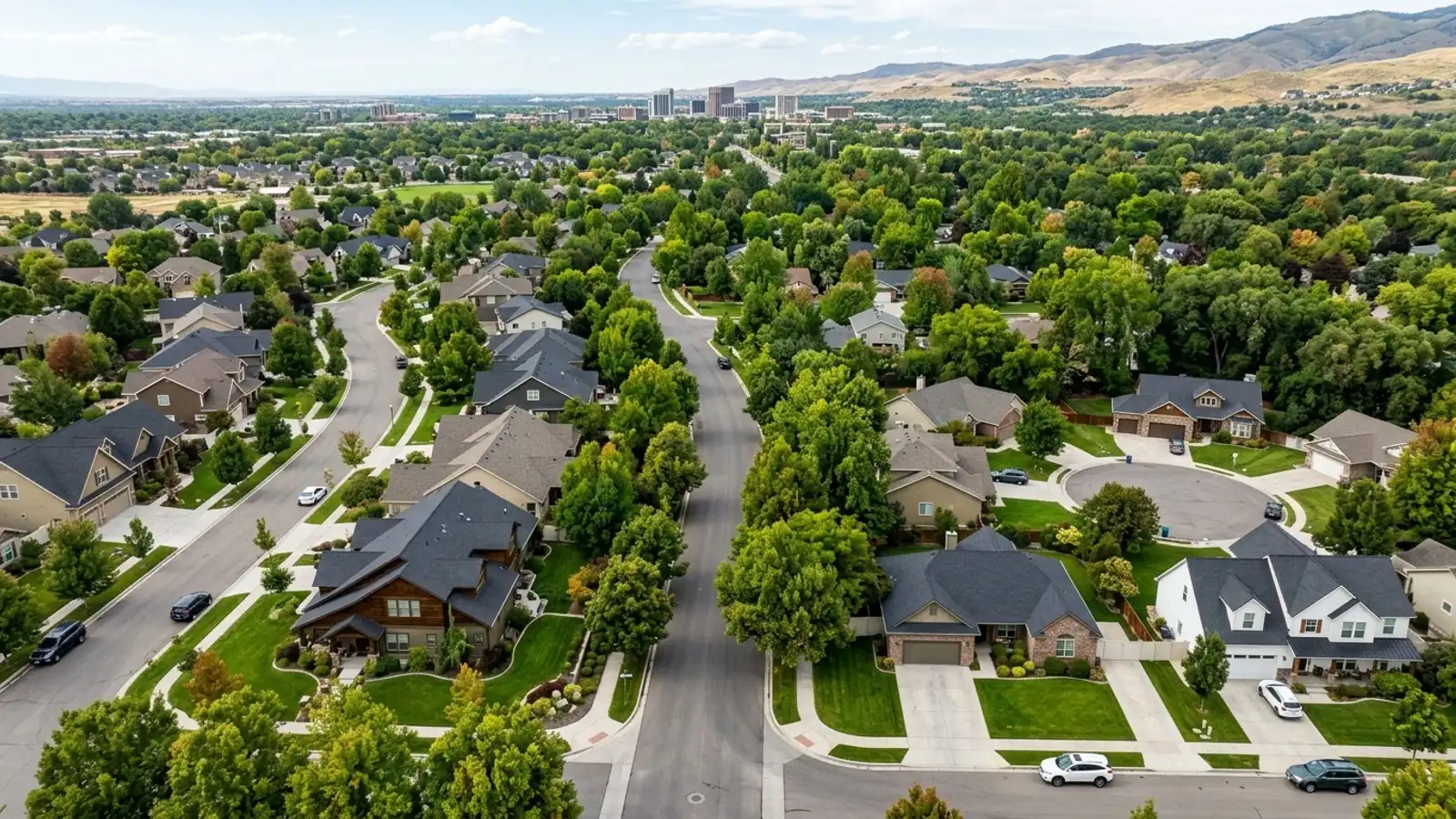
As of mid-2026, the median sale price for a home in Boise, ID sits at roughly $535,000, and properties are spending just 11 days on the market. Inventory is tight – 1.3 months of supply – which means buyers in the Treasure Valley need to move fast and come in strong.
Before you decide whether Idaho’s capital makes sense for your family, you’ll want to look past the scenery and understand what day-to-day life actually costs here. Housing, commute times, climate, and local amenities all factor in, and none of them are simple.
The Reality of Relocating to Boise, ID
The Boise metro area is home to roughly 840,717 residents. It’s a real city – urban amenities, a growing economy, a humid continental climate – but it still offers genuine access to the outdoors in a way that most metros its size don’t. Overall cost of living runs about 3% above the national average, which is worth understanding before you assume it’s a bargain compared to wherever you’re coming from.
Buyers here weigh 29 local parks and a 23-minute average commute against rising housing costs and some real environmental considerations. Neither side of that ledger is trivial.
Everyday Benefits of the Area
Commute times are genuinely shorter than the national average of 26.4 minutes, and that’s not a small thing if you’ve been sitting in traffic for an hour each way. You also get four distinct seasons and extensive recreational access without driving three hours to find it.
The local economy supports a median household income of $81,102, which tracks closely with the national figure. Boise also maintains a solid network of public, private, and charter schools, so families have real options.
Drawbacks and Tradeoffs to Consider
The median home price hovering around $535,000 is where a lot of buyers pause – and 34% of homes are selling above list price, so the market doesn’t reward hesitation. You’ll need a realistic pre-approval and a clear strategy before you start writing offers.
There’s also the wildfire question. Redfin’s Fire Factor data shows that 60% of properties in Boise face wildfire risks over the next 30 years. That has implications for insurance rates and, frankly, for the air you’re breathing in August.
Boise’s Location Within Ada County
Boise City covers over 130 square miles and is the largest, most populated city in Idaho. It sits at the center of Ada County and anchors the broader Treasure Valley region – which means it drives traffic patterns, county service zones, and a lot of the pricing pressure you’ll feel as a buyer.
The city connects directly to neighboring municipalities like Meridian, Eagle, and Kuna. Where you land relative to those borders matters more than most people realize until after they’ve closed.
Proximity to the Treasure Valley
For commuters, the Treasure Valley functions as one interconnected metro. Boise is the primary employment hub, drawing workers from suburbs across both Canyon and Ada counties. Buyers willing to commute often look outside city limits for different price points or housing styles, and the highway system does connect those outer communities directly to downtown – though “connected” and “quick” aren’t always the same thing during peak hours.
Population and City Size
The 2020 Census put Boise City’s population at 236,033. More recent 2026 estimates place it around 238,853, a growth rate of roughly 0.18% annually – steady rather than explosive, but persistent enough to keep pressure on infrastructure and housing supply. Population density shifts considerably between the downtown core and the outer neighborhoods, which is part of why two houses with similar price tags can feel like very different purchases.
Understanding Boise Crime Statistics
The most current FBI-based crime data for Boise covers the 2024 calendar year, released by the agency in September 2025. The Idaho State Police also published their “Crime in Idaho” 2025 annual report in mid-2026, covering District 3 and Ada County.
I’d encourage you to go to those primary sources rather than relying on third-party rankings. Local law enforcement provides direct access to neighborhood-level incident reports, and that granularity matters.
How Local Agencies Measure Crime
The Boise Police Department and the Ada County Sheriff’s Office each track incidents across their respective jurisdictions and submit that data to the FBI’s uniform reporting systems. Jurisdictional lines are real – unincorporated parts of Ada County fall under the Sheriff’s purview, while city addresses go to Boise police. The agency that covers your specific address affects which data set is actually relevant to you.
Where to Find Official Police Data
The Boise Police Data & Dashboards hub hosts a public crime map for city addresses. You can filter by incident type and view activity on a block-by-block basis. For anything outside city limits, the Ada County CrimeMapper covers Boise, Meridian, Eagle, Kuna, Star, and unincorporated zones. It updates daily and includes data going back to January 1, 2022.
Researching Specific Addresses
Run any address you’re seriously considering through both tools. It’s a 10-minute exercise that gives you a factual look at local incident trends over the past few years – no subjective neighborhood labels, just actual data. Do it before you fall in love with the kitchen.
Housing Costs and Everyday Expenses in Boise
Boise’s overall cost of living runs about 3% higher than the national average. Redfin data from mid-2026 shows a median home sale price of $534,709, with an average sale-to-list ratio of slightly over 100%. There are currently just 440 homes available across the market, which is what’s driving the multiple-offer situations you’ll encounter near the median price point.
Home Prices and Rental Rates
ACS data from 2024 placed the median property value at $468,900, but recent MLS activity shows prices have climbed since then. Zillow’s Home Value Index puts the average Boise home value around $508,258, reflecting a 0.9% year-over-year increase. For buyers who want to lease before committing, Niche reports a median rent of $1,446 per month. The homeownership rate sits at 72.5%, which tells you something about how long-term residents here tend to think about housing.
General Affordability Compared to National Averages
Groceries and utilities track fairly close to national baselines – it’s housing that moves the needle. Median home sale prices in Boise run roughly 15 to 33% above the national median, depending on the specific quarter measured. If you’re relocating from a high-cost coastal market, these prices may still feel approachable. If you’re buying on a local salary, the math requires careful attention to property taxes and insurance alongside the purchase price.
Population Growth and Demographics
According to ACS 2024 data, Boise City’s median household income is $81,102 – nearly identical to the Idaho state median of $81,166 and the U.S. median of $81,604. Per capita income sits at $49,839. The workforce spans healthcare, technology, and government sectors, and roughly 12.9% of residents live below the poverty line, a figure consistent with many mid-sized cities.
Age Profile and Median Income
The median age in Boise is 38.6 years – 37.6 for males and 39.7 for females. The adult population numbers 193,376, which includes 38,505 seniors. That distribution reflects a genuine mix of working professionals, students, and retirees rather than a market skewed hard in any one direction.
Civic Life and Local Amenities
Public libraries, community centers, and regional event spaces are woven into the city’s fabric, and the local government has been updating infrastructure to keep pace with the 1.19% population increase since 2020. Local events and seasonal festivals run throughout the downtown corridor, using the city’s public squares and riverfront paths. It’s an active civic life, not just a collection of chain restaurants around a highway interchange.
Climate, Weather, and Outdoor Access
Boise has a humid continental climate – four distinct seasons, hot dry summers, and a valley geography that influences temperature inversions and precipitation patterns. The access to the outdoors is a genuine draw: the metro is served by 29 parks and recreational areas, and the foothill trails are minutes from the urban center, not an hour.
That said, summer comes with tradeoffs worth understanding before you sign anything.
Wildfire Risks and Weather Patterns
Elevated summer temperatures bring elevated fire risk. Redfin’s Fire Factor data shows that 60% of properties in Boise face wildfire risks over the next 30 years, and smoke from surrounding states regularly settles into the Treasure Valley during late summer. Air quality on those days is not trivial. Winter brings moderate snowfall and standard seasonal maintenance obligations – nothing unusual for the region, but worth factoring into your planning.
Parks and Recreation
The Boise River Greenbelt alone connects multiple municipal parks along a paved pathway that gives residents miles of uninterrupted pedestrian access. All 29 recreational areas support cycling, hiking, and water activities. If outdoor access is high on your list, Boise delivers on that in a way that’s immediate and practical, not aspirational.
Comparing Boise to the Broader Treasure Valley
Ada County homes carry a notably higher price tag than those in neighboring Canyon County. In one recent month, Ada County’s median sold price reached $575,843, while Canyon County came in at $444,502. That’s a meaningful gap – over $130,000 – and it’s the first question worth answering before you decide where to focus your search.
Housing Tradeoffs in Neighboring Counties
Canyon County offers more new construction, larger lots, and a lower entry price. The tradeoff is real distance from Boise’s downtown employment centers, which shows up in your commute time and, potentially, your gas budget. Ada County puts you closer to major hospitals, the airport, and the central business district. Whether that proximity justifies the higher purchase price depends entirely on how you spend your weekdays.
Commute Times Across the Metro
Boise City residents average a 22.9-minute commute, which comes in under the national average of 26.4 minutes. For Canyon County commuters, that number climbs considerably during peak hours on Interstate 84, which is the primary artery connecting the Treasure Valley and is carrying noticeably more traffic as the region grows.
Specialized Housing Options in the City
Boise offers a range of specialized housing facilities to support its 38,505 senior residents and others who need structured environments – from independent living communities to dedicated care centers. Zoning laws and city planning distribute these facilities across both residential and commercial zones, so options aren’t concentrated in one corner of the map.
Senior and Assisted Living Facilities
Assisted living in Boise, ID ranges from large campus-style communities to smaller residential care homes, with tiered levels of medical support and daily assistance based on resident needs. Senior living in Boise, ID also includes 55+ communities built around independent, maintenance-free lifestyles, typically with shared amenities like clubhouses and fitness centers.
Sober Living Environments
Sober living in Boise, ID provides transitional housing for individuals recovering from addiction. These residences operate with strict house rules and structured peer support, and they’re distributed throughout the city to keep residents close to public transit and employment opportunities – functioning as a practical bridge between inpatient treatment and independent housing.
Local Amenities, Schools, and Healthcare
Boise falls within the Ada County R-1 School District, which encompasses 77 elementary, 40 middle, and 29 high schools regionally. The city itself hosts 66 public schools alongside 36 private and 10 charter options. Beyond education, the city’s infrastructure supports healthcare networks and entertainment districts that serve the daily needs of its 238,853 residents.
Ada County R-1 School District Boundaries
The Ada County R-1 district assigns enrollment based on geographic zones, and those boundary lines don’t always follow neighborhood edges in intuitive ways. Verify the exact boundaries on the district website before you make any assumptions about which school a specific address feeds into. The 10 charter schools and 36 private institutions give families alternatives, each with their own enrollment procedures and tuition structures.
Nightlife and Dining Access
Downtown Boise has a real concentration of restaurants, breweries, and live music venues. The 8th Street corridor is the primary hub for dining and evening activity. Outer neighborhoods have their commercial centers too, though they lean toward familiar chains and family-style restaurants. Most residents rely on personal vehicles to get around – public transit connects some commercial districts, but it’s not the backbone of how people move through this city.
Healthcare and Senior Services
Regional hospitals and specialized clinics operate throughout the Treasure Valley, handling both emergency and routine care for a metro population of over 840,000. Senior services include dedicated transit options and community health programs. The density of medical infrastructure in Boise makes it a practical choice for residents who need regular care, which is worth factoring in if that’s part of your household’s situation.
Frequently Asked Questions
Is the cost of living in Boise, ID still lower than the West Coast after the recent housing boom?
Yes, it generally remains lower than major West Coast hubs, though Boise’s overall cost of living is now about 3% higher than the national average. Median home prices sit around $535,000, which is roughly 15 to 33% above the U.S. median.
Are Boise home prices currently dropping, or is it a good time to buy real estate?
Prices are currently rising slightly. Mid-2026 MLS data shows the median sale price at $534,709, reflecting a 2.9% year-over-year increase, with homes selling in a median of just 11 days.
Should I buy a house in Boise proper, or look at surrounding suburbs like Meridian and Nampa?
It depends on your budget and commute tolerance. Ada County homes have a higher median price of about $575,843, while neighboring Canyon County offers a lower median around $444,502 but requires a longer drive into Boise.
Does Boise get a lot of snow, and how bad is the air quality during summer fire season?
Boise receives moderate winter snowfall as part of its humid continental climate. During late summer, smoke from regional wildfires can affect air quality, and 60% of local properties face wildfire risks over the next 30 years.
Are property taxes in Boise high compared to other popular relocation cities?
Property taxes vary by specific county and municipality. Buyers should review current Ada County tax rates and factor them into their monthly housing budget alongside the $535,000 median home price.
How well is the local traffic and infrastructure keeping up with Boise’s rapid population growth?
The city has seen a 1.19% population increase since 2020, bringing the total to roughly 238,853 residents. Despite this growth, Boise City residents still average a 22.9-minute commute, which remains shorter than the 26.4-minute national average.
Social Cookies
Social Cookies are used to enable you to share pages and content you find interesting throughout the website through third-party social networking or other websites (including, potentially for advertising purposes related to social networking).