

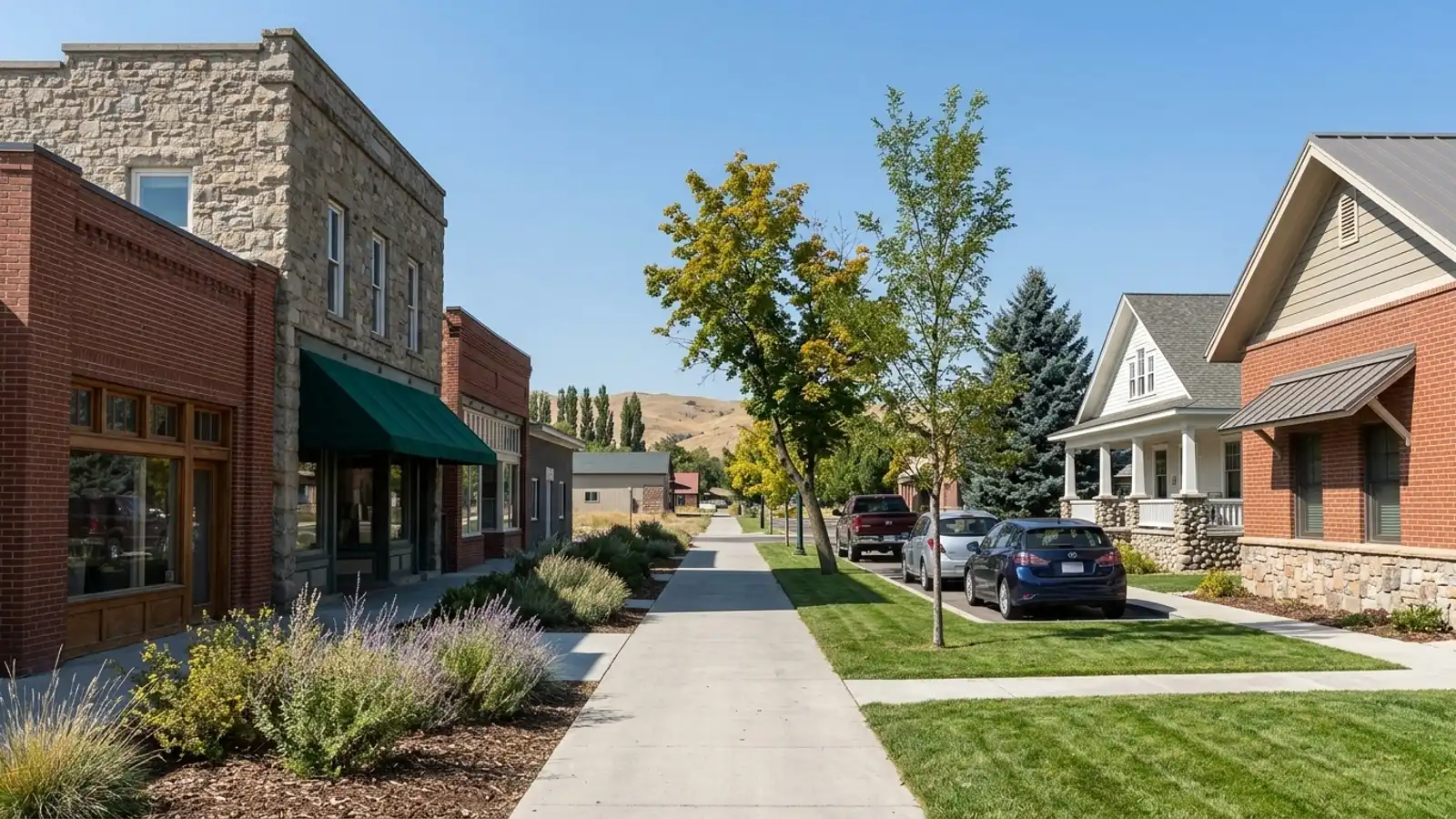
Eagle sits in Ada County, roughly ten miles northwest of downtown Boise. It started as a river farming settlement in the 1860s, and that origin still shows up in the housing market today.
The land that once held irrigation canals now holds mostly detached single-family houses. That’s not a coincidence. It’s the direct result of how the city grew, and it’s why the homes you’ll tour look the way they do and cost what they cost.
Key Takeaway
Eagle started as a farming settlement on the Boise River around Eagle Island in the 1860s and became an incorporated city in 1971, growing mostly by turning farmland into subdivisions. That history is why the homes you will tour are mostly detached single-family houses, which made up about nine in ten sales in the 90 days ending Sept. 30, 2026. Townhouses are the smaller, newer alternative where buyers currently have more room to negotiate.
Who This Guide Is For
You’re weighing a move to Eagle and want to understand how the town’s past shaped its downtown, its neighborhoods and the kinds of homes you will be choosing between.
A Short History of Eagle, Idaho
Eagle grew from a river farming settlement into a city by subdividing farmland, and that path still shapes what you can buy. The local housing inventory favors detached houses on former agricultural lots, which drives the property types available today.
Eagle Island was first settled in the 1860s. Truman C. Catlin obtained a preemption claim on 160 acres of the island in the latter half of 1863 and received his official homestead patent in 1869. Catlin and his neighbor Polete Mace built the area’s first irrigation ditch in 1864, diverting water from the Boise River to irrigate about 700 acres of the island.
The area operated as a rural community for over a century before Eagle was incorporated as a city in February 1971. The Ada County Commission approved the new city with a starting population of just 359 people.
How Eagle Got Its Name
Eagle Island received its name from early settler Truman Catlin, who called it Eagle Island because of the bald eagles that nested along the Boise River there.
When the surrounding township was later organized, it took the same name. Accounts of early naming generally trace back to this specific connection between the river channels, the island and the local wildlife.
Settlement and Farming Along the Boise River
Truman Catlin obtained water right number 4 on the Boise River to support his initial 700-acre irrigation ditch on Eagle Island. By 1903, settlers had completed nine major irrigation canals to irrigate what is today’s Eagle, roughly forty years of effort to bring water to higher ground.
Some properties on former farm parcels still carry irrigation water rights and an irrigation district or ditch-company assessment. Before making an offer, ask the seller and the title company whether the property has irrigation water rights, which entity delivers the water and what the annual assessment is. Those fees factor into your overall carrying costs, and readers can review buyer closing costs to see how they fit into a purchase.
Downtown Eagle and Its Historic Buildings
The original town core retains several structures from its early decades. According to the Idaho State Historical Society, downtown Eagle properties individually listed on the National Register of Historic Places include Aiken’s Hotel at 99 E. State St. and the Bushnell-Fisher House at 349 W. State St. The Eagle Adventist School and the Orville and Floy Jackson House at 127 S. Eagle Rd. are also listed.
The City of Eagle’s Register of Historic Sites identifies additional local landmarks like the Carpenter/McAdams House and Eagle Hotel.
If you’re buying near downtown, know that changes to exteriors or new construction may face design review or overlay rules. Under Eagle City Code Chapter 9, no exterior portion of any building within a designated historic district may be demolished, and no new construction or outdoor signs may be undertaken, until a permit application is approved by the Eagle Design Review Board and the Historic Preservation Commission. Check with the City of Eagle planning department before planning exterior changes to any property near the core. Buyers comparing downtown with newer subdivisions can check the best neighborhoods guide for lot differences.
From Farm Town to Incorporated City
Following its 1971 incorporation, Eagle transformed rapidly from an agricultural center into a residential suburb. According to U.S. Decennial Census figures, the population was 2,620 in 1980, grew to 11,085 in 2000 and reached 30,346 by 2020.
As the population expanded, subdivisions replaced the surrounding farmland. That outward growth established the detached-home neighborhoods that define the local real estate market today. Buyers can review Eagle housing market trends to see how this inventory performs month to month.
How Eagle’s History Shapes the Homes You Can Buy
Detached houses are the norm because Eagle grew by subdividing land. That brings the space of single-family streets and the associated costs. If you want a detached house with a yard, single-family listings are where you’ll start, and you’ll want pre-approval in hand before you tour.
Houses here move fast enough that some buyers pay over asking. In the 90 days ending Sept. 30, 2026, 18.1% of single-family homes sold above list, while the single-family median sale price sat at $997,053. Settle on your ceiling before you walk into a showing.
Subdivision-level prices and lot details vary across communities like Brush Creek, Legacy and Rivers End. A full breakdown of property styles and HOAs is in the types of homes guide.
Townhouses in Eagle
Townhouses are the newer, denser exception to Eagle’s detached-home pattern, and right now they’re where buyers hold the most negotiating power. If you want an Eagle address under $500,000, start here.
The townhouse median sale price is $460,455, based on only 27 sales in the 90 days ending Sept. 30, 2026, so that median can swing. Townhouse supply sits at 5.6 months, which gives you room to negotiate on price, repairs or credits. To put that in context, it would take about 5.6 months to sell every listed Eagle townhouse at the current pace, more than twice as long as for single-family homes.
The tradeoff is that the townhouse market is small and thin. The same slow pace that helps you negotiate now can mean a longer sale when you’re ready to move on. HOA dues vary by community, so ask for current dues, what they cover and the latest reserve study before you commit.
Where to See Eagle’s History Today
The Eagle Museum of History and Preservation sits at 660 E. Civic Lane. Admission is free, with donations accepted, and standard hours run Tuesday through Saturday. Confirm current hours and any admission details with the City of Eagle before visiting, since seasonal schedules change.
Eagle Island State Park offers a look at the area’s past land use. First purchased by the State in 1929, the site operated as a penitentiary honor farm from 1930 until 1977. The Idaho Department of Parks and Recreation eventually took over, and the park was dedicated in 1983.
The Eagle Fish Hatchery was constructed in the late 1940s as part of the resident trout program. In 1991, it was reconfigured to support the Snake River sockeye salmon captive broodstock program to prevent the fish’s extinction. For more context on local amenities, review the pros and cons of living in Eagle.
How to Narrow Your Eagle Home Search
Eagle’s housing inventory splits buyers between the historic town center and newer developments built on former farmland. The questions worth asking yourself before you start: Do you want to be near Eagle’s historic downtown core, or in a newer subdivision on former farmland? Is your budget closer to the townhouse median or the single-family median in the at-a-glance list below? Does the property carry irrigation water rights or ditch access, and do you want the upkeep and assessments that come with it?
See the downtown section above for what to know about the historic core, then check the best neighborhoods guide for subdivision-level prices.
If you’d like help comparing homes near downtown with newer subdivisions, Traci Odem with Compass can walk you through current listings. You can also explore the guide to buying a home in Eagle and learn how to choose a buyer’s agent. All figures here are a 90-day snapshot, not a forecast.
At a Glance
- All homes: median sale price $899,572, up 12.5% year over year, 310 sales (90 days ending Sept. 30, 2026). The all-homes change is higher than either single-family or townhouse change below, so read it partly as a shift in which homes sold, not purely as rising prices.
- All homes: median 70 days on market, 99% sale-to-list, 16.4% sold above list, 2.9 months of supply, 296 homes in inventory, $345 median price per sq ft (90 days ending Sept. 30, 2026).
- Single-family: median sale price $997,053, up 8% year over year, 280 sales (90 days ending Sept. 30, 2026).
- Single-family: median 66 days on market, that same sale-to-list ratio, 18.1% sold above list, 2.6 months of supply, 237 homes in inventory, $350 median price per sq ft (90 days ending Sept. 30, 2026).
- Townhouse, based on only 27 sales so figures can swing: median sale price $460,455, up 1.4% year over year (90 days ending Sept. 30, 2026).
- Townhouse, based on only 27 sales: median 80 days on market, sale-to-list in line with the all-homes figure, 0% sold above list, 5.6 months of supply, 49 homes in inventory, $250 median price per sq ft (90 days ending Sept. 30, 2026).
Eagle, Idaho History FAQs
What County Is Eagle, Idaho In?
Eagle is located in Ada County, Idaho. The city limits sit roughly ten miles northwest of downtown Boise.
Is Eagle, Idaho Its Own City or Part of Boise?
Eagle is a separately incorporated city. It was incorporated in February 1971 by the Ada County Commission and sits approximately 10 miles northwest of downtown Boise via State Highway 44.
What Is the Population of Eagle, Idaho?
The most recent American Community Survey 5-year estimate for 2024 places the population at approximately 32,855. That’s significant growth from the 359 residents recorded at its incorporation in 1971.
What Is the Elevation of Eagle, Idaho?
Eagle sits at an elevation of 2,599 feet above sea level.
What Is the ZIP Code for Eagle, Idaho?
The primary ZIP code for Eagle is 83616. Secondary ZIP codes 83629 and 83646 are also partially assigned to the area. You can review the Eagle ZIP codes page for area-by-area details.
Is Eagle, Idaho Expensive to Live In?
It depends on the type of home you buy. The median sale price for all homes was $899,572 over the 90 days ending Sept. 30, 2026, but that varies widely by property type. The pros and cons page and the Eagle housing market page have more detail.
Sources
- Redfin: Data Center
- Idaho Friends: Eagle Island Facts
- Idaho Friends: Eagle Island Narrative
- City of Eagle: State of the City 2019 Transcript
- Idaho State Historical Society: National Register of Historic Places
- American Legal Publishing: Eagle City Code
- Wikipedia: Eagle, Idaho
- Census Reporter: Eagle, ID Profile
- Idaho Parks and Recreation: Eagle Island State Park
- Idaho Department of Fish and Game: Eagle Fish Hatchery
- City of Eagle: Eagle Museum of History and Preservation
- USGS National Map: Eagle, ID
Social Cookies
Social Cookies are used to enable you to share pages and content you find interesting throughout the website through third-party social networking or other websites (including, potentially for advertising purposes related to social networking).